





Temple Old Kirk: A medieval church creates digital archive
A grant of £1,000 from the Carcant (Moorfoot) Community Fund supported the creation of a searchable memorial register for a medieval church.
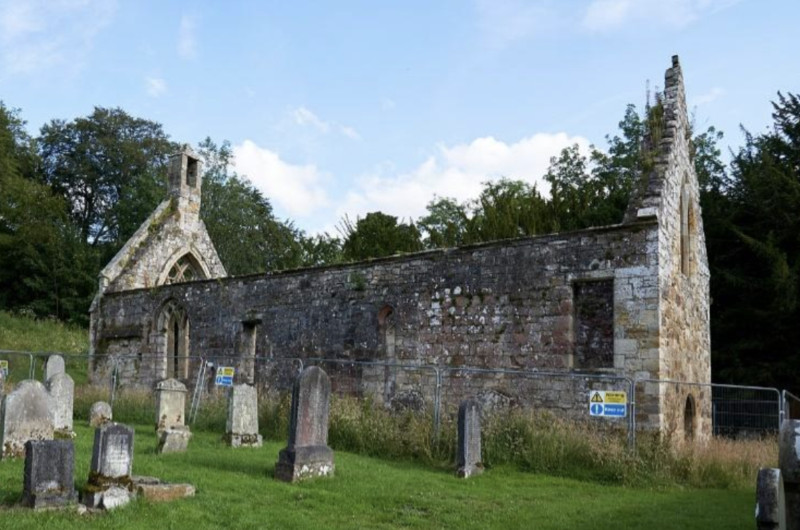 Temple Old Kirk Friends is a volunteer-led SCIO working to conserve a medieval church ruin in the village of Temple, Midlothian. The church is a historic building with roots stretching back to the Knights Templar in the 12th century. With public access physically challenging due to the steep terrain, no parking and an unstable structure, Temple Old Kirk Friends identified a digital archive as the most inclusive way to open the site to a wider public.
A grant of £1,000 from the Carcant (Moorfoot) Community Fund supported the creation of a searchable memorial register for the churchyard, developed by trained volunteers in partnership with Archaeology Scotland's Adopt-a-Monument programme and Recording Angels. The register includes a record of every headstone, its inscription and its condition,
What the project delivered
The completed archive is publicly accessible at templeoldkirk.org. It allows anyone (in Scotland or internationally) to search the memorial register by name, date or other fields, and to view photographic records of each stone. This project sought to ensure a legacy, as many inscriptions will fade or be lost over time.
The project faced a number of challenges: reconciling data formats across three organisations, handling large image files for web accessibility, and navigating the wind-down of one partner (Recording Angels). The group worked through these systematically, and by the end of the project had delivered a live, searchable resource available to everyone.
A Temple Old Kirk Friends Trustee said:
| “Our new website has been an important part of our efforts to expand our outreach and the archive database is particularly important to that, and we are immensely grateful for the support we have received from the Carcant (Moorfoot) Fund which made this possible.” |

What comes next
With structural repairs on the original Kirk nearing completion, the group plans to remove the Heras fencing and open the Kirk interior to visitors. The digital archive will expand to include images, video and drone footage of the building itself, extending its reach to those who cannot visit in person and preserving a record of this phase in the site’s history.
Foundation Scotland and the IVAR principles:
How a trust-based, flexible funding relationship supported a project that took longer than planned.
Foundation Scotland’s grantmaking is grounded in the IVAR principles — a framework for funders who want to shift power toward communities and treat grantees as partners rather than recipients. The Temple Old Kirk project is a practical illustration of what this looks like in action.
| I | Inclusive | Funding reached a small, all-volunteer group whose work serves residents, visitors and international audiences who cannot reach the site physically. |
| V | Values-led | The grant supported the group's own articulation of need — extending access to heritage, rather than requiring the project to fit a prescriptive programme shape. |
| A | Accountable | The group reported honestly on delays, partner changes and unspent funds, and the funder relationship created space for that transparency rather than penalising it. |
| R | Responsive | When progress was slower than anticipated, due to data complexity and organisational changes among partners, the funding remained available, allowing the group to complete the work on a realistic timeline.
|
In practice, this meant Foundation Scotland did not treat delays or evolving plans as signs of poor management. The group navigated a complex landscape, including unstable structures and partner wind-downs, while delivering a lasting public resource. Flexible, trust-based funding made that possible.
Read more about the Carcant Wind Farm Community Benefit Fund - Moorfoot.